
Labourers aided by means of the Mahatma Gandhi Nationwide Rural Business Assurance Operate (MGNREGA), paintings at a building website at the outskirts of Amritsar on July 23.
| Photograph Credit score: AFP
The tale to this point: Ladies-led construction left-overs on the core of bulletins made by means of the Finance Minister (FM) on this life’s Finances. This constancy to ladies empowerment used to be mirrored in Finances allocations to pro-women programmes, as reported by means of the Gender Finances Commentary (GBS). The GB reached 1% of GDP estimates in 2024-25 for the primary year, and general allocations lately arise at greater than ₹3 lakh crore for pro-women programmes.
What’s the reason why for the rise?
The GBS, because it used to be first offered in 2005-06, persistently reported a mean proportion of five% of the full budgetary allocations, with marginal ups and downs. This life is particular as the percentage of allocations to pro-women schemes stands at roughly 6.8% of the full price range expenditure for 2024-25, which is much above the regular tendencies and marks a good leaving from situation quo.
The rise in GB allocations are pushed by means of two elements. Part of this build up has been as a result of the newly integrated Section ‘C,’ a 3rd phase within the GBS that reviews pro-women schemes with not up to 30% provisioning for girls. The PM Kisan scheme within the agriculture sector has been reported partially C with an outlay of ₹15,000 crore. That is 25% of the full outlay of the programme. The second one issue using the whole build up is the increment partially A of the GBS. Section A reviews expenditures in schemes with 100% allocation for girls.
Section A had in the past constituted 15-17% of general allocations reported within the GBS until BE 2022-23. Since BE 2023-24, there used to be a unexpected build up within the allocations partially A that raised the percentage of pro-women schemes with 100% allocations for girls to just about 40% (determine 1).
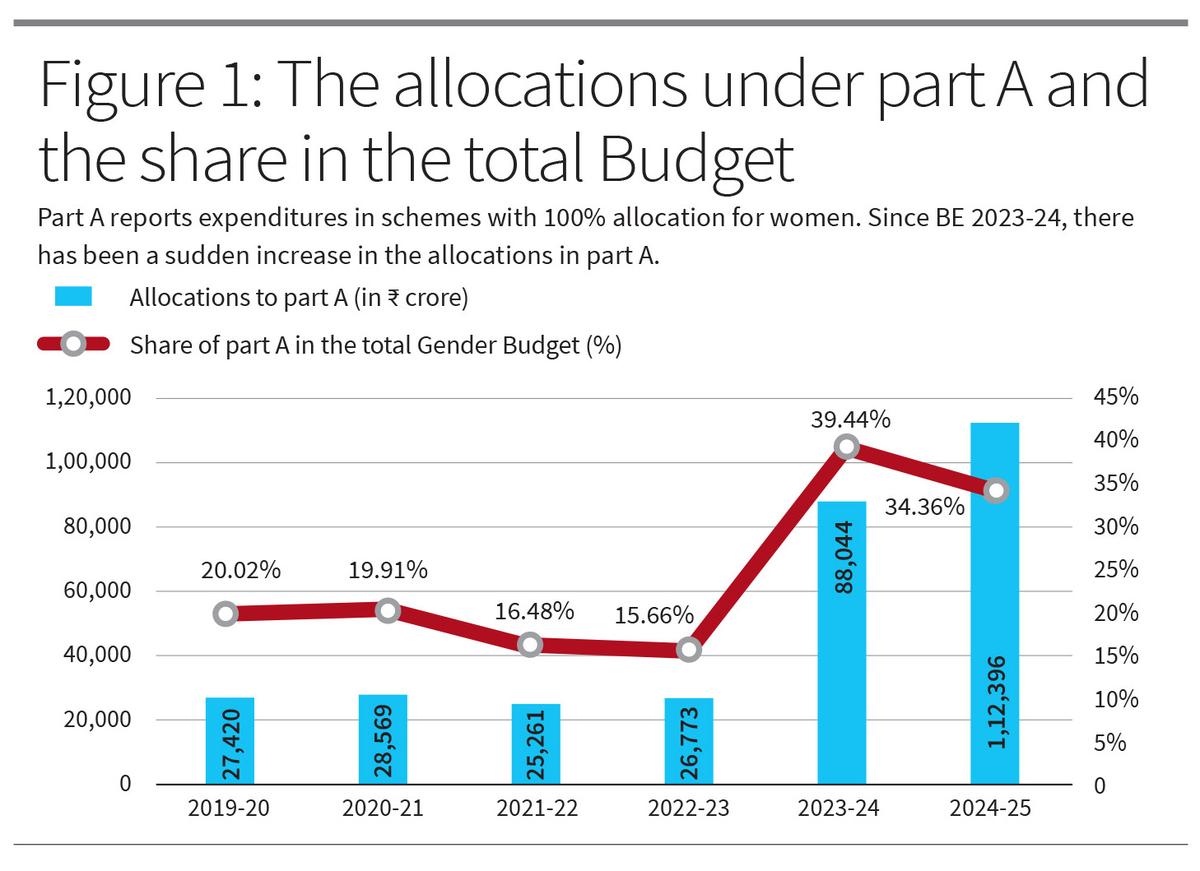
This used to be principally because of a transformation within the reporting the place the Pradhan Mantri Awas Yojana (PMAY) — rural and concrete — began getting mirrored partially A rather of phase B. Section B of the GBS reviews programmes with allocations of 30-99% for girls. Therefore, simplest part of PMAY used to be reported previous. Starting terminating life, all of the allocation of ₹80,670 crore in PMAY for 2024-25BE has been reported below phase A thus using the up allocations. Such reporting of PMAY might not be solely correct as now not all beneficiaries are ladies.
Have there been alternative circumstances of over-reporting/under-reporting?
Over-reporting can be present in alternative circumstances such because the PM Business Presen Programme (PMEGP), which goals to lend a hand marketers in putting in place micro companies within the non-farm sector. The GBS reported an allocation of ₹920 crore or 40% of the full allocation to PMEGP, with out offering any cause of such reporting.
At the alternative hand, lacking allocations regularly deflate the quantity spent by means of programmes on ladies’s wishes. For instance, this life for the primary year all of the allocation to the Nationwide Rural Livelihoods Undertaking (NRLM) is mirrored partially A of the GBS, indicating that 100% of its outlay is devoted to girls and women, which is technically right kind and will have to were carried out previous. In 2023-24BE, simplest 50% of the scheme’s overall outlay impaired to be mirrored partially B of the GBS. The GBS this life has additionally as it should be reported larger allocations for the Ministry of Electronics & IT. But it surely ignored out reporting pro-women allocations within the schemes for girls marketers comparable to PM Vishwakarma, SVANidhi, and Get up-Up Bharat.
In any other example, the Mahatma Gandhi Nationwide Rural Business Assurance Scheme (MGNREGS), which has the 3rd best possible allocation amongst schemes for girls within the GBS, is lately reported below phase B with ₹28,888.67 crore which is 33.6% of its overall outlay. It’s impressive to notice that ladies constituted 59.3% of all individual days below MGNREGA as of December 2023, and will have to have won commensurate wages from the full MGNREGA price range, but simplest 33.6% will get mirrored within the GBS.
What then?
Those anomalies will also be minimised by means of incorporating explanations for the entries made within the GBS. Incorporating explanations for allocations in GBS would now not simplest safeguard accounting accuracy however will assistance in gender audits and handover pathways for advanced gender results in govt programmes. A number of years of advocating for advanced reporting within the GBS by means of mavens is mirrored within the inclusion of a 3rd phase. The above anomalies in reporting are reflections of the GBS nonetheless now not having a systematic and systematic method.
Efforts to drop misreporting and enhance the constituent of the GBS is not hidden, however there’s nonetheless an extended method to move. The desire for together with rationale could also be to guard that crystal clear reporting isn’t a trifling workout in expanding the quantum of allocations reported for girls’s construction — it’s to safeguard latest spending for girls in all govt programmes, which are neatly deliberate and designed to incorporate ladies’s wishes from its inception. Gender responsive budgeting is an impressive instrument to akin the gender gaps in an financial system.
Sona Mitra and Sruthi Kutty paintings with IWWAGE, an initiative of LEAD at Krea College, and Sonakshi Chaudhry works at The Quantum Hub (TQH Consulting).


